Direction
Aline Tenu (CNRS – UMR 7041 ArScAn)
How Eveha Participates
Archeozoological analyses
Archaeological investigations
Location
Iraq

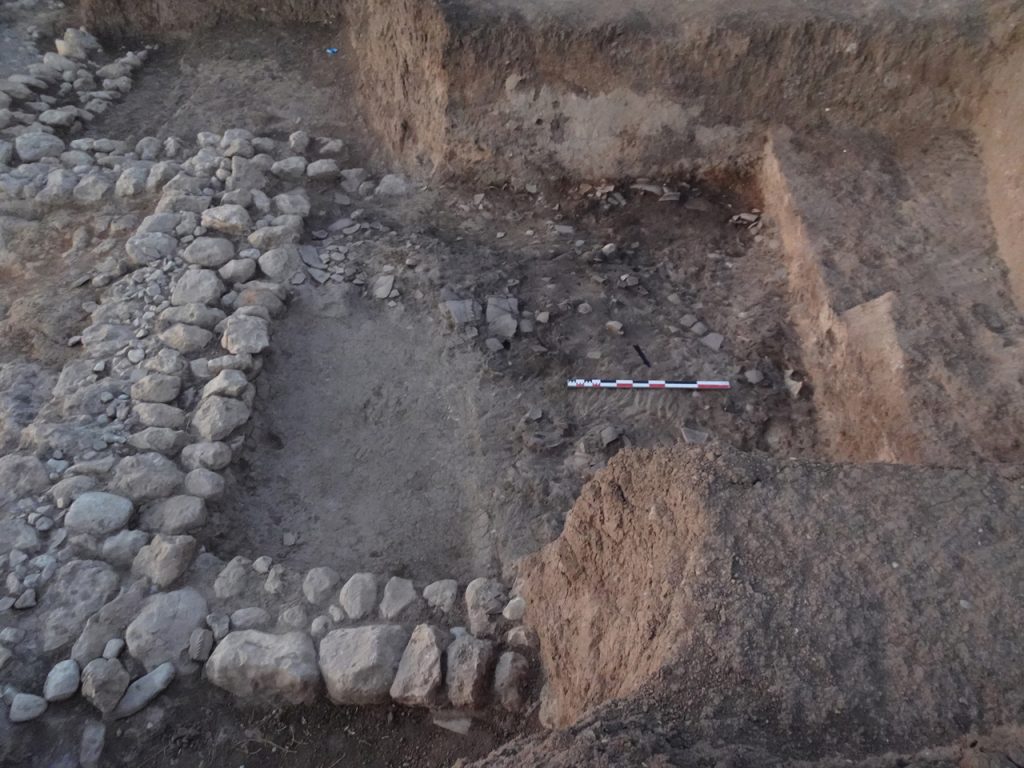
The eighth excavation campaign at Kunara took place from October 5 to 28, 2022. Work continued in the lower town on sites B, C, and E, which had been opened in previous years, and resumed in the upper town on site A, where the last mission had taken place in 2013.
Site A (Christine Kepinski)
The only site located in the upper town, Site A yielded in 2012-2013 a terrace approximately 3.50 m high, on top of which two buildings were successively constructed. Of the more recent building, some of whose walls are 2.80 m thick, only a small part of a courtyard and one room had been excavated. The excavation focused on the northern area of this monumental building. It revealed a corridor, a stairwell, two new walls, and completed the plan of the building, which may have been oval in shape.
Site B (Aline Tenu)
Exploration of building B. 715 continued. Two rooms were partially excavated (L. 742 and L. 755). They yielded, in the middle of a carefully placed fill, several ceramic vessels with elaborate decorations featuring birds, fish, snakes, scorpions, chariots, and horsemen.
Site C (Barbara Chiti)
Two areas were excavated. In the northwest, the excavation revealed a building probably dating from the Iron Age. In the east, two levels from the end of the third millennium were identified. The first corresponds to the main period of occupation of Kunara (period V), the second immediately followed the destruction of the first. The walls of a new building (B. 1001) made of schist blocks, which is unique at this stage, also date from the end of the third millennium.
Site E (Florine Marchand)
The excavation focused on two areas of the monumental building B. 659. In the northwest, the excavation of room L. 922 began, while three rooms were explored in the southeast corner. The excavation of L. 915 was completed this year. This room was certainly a bathroom, as evidenced by the terracotta tile covering on the floor and at the base of the walls, as well as the drainage system discovered in the southwest corner of the room. The floor of the three rooms where we worked in 2022 was covered with ceramic shards, particularly from large storage jars.
In the fall of 2022, the sites were photographed by drone (Felix Wolter), complementing the surveys carried out by Julien Soichet. The ceramic (Cécile Verdellet) and archaeozoological (Michaël Seigle) studies continued, while Carolyne Douché undertook the flotation collection and analysis of the archaeobotanical remains.