Direction
William Van Andringa (Université Lille III – CNRS, UMR 8164 – HALMA-IPEL)
Thomas Creissen (Éveha International – Université François Rabelais Tours, CNRS UMR 7324 – LAT)
Henri Duday (Université de Bordeaux – Laboratoire d’Anthropologie de Bordeaux)
How Eveha Participates
Archaeological investigations
Glass material study
Location
Italy

In 2021, Éveha International was involved in the new excavation campaign dedicated to the study of Pompeii’s necropolises as part of a project led by William Van Andringa (EPHE) and Henri Duday (Laboratoire d’Anthropologie de Bordeaux).
The work focused in part on the funerary monument of Marcus Tullius, an important euergetes of Pompeii, to whom the city owes, in particular, the construction of the Temple of Fortune Augusta (https://eveha-international.com/?intervention=pompeii). His funerary monument, which dates back to the Augustan period, takes the form of a semicircular bench. It was built on public land adjacent to the Stabia Gate, just outside the city, which clearly illustrates the special status of its recipient.
Most of the fieldwork focused on the eastern part of the Porta Nocera necropolis, an area that has been excavated since 2015. Our work there focused more specifically on the excavation of enclosure 3E. Successive excavation campaigns, carried out since 2014, have identified 14 graves set against the walls of the enclosure and a very large cremation area, clearly associated with the graves, which occupies the central part. The excavations, carried out between 2019 and 2020, suggest that this was a pyral tomb.
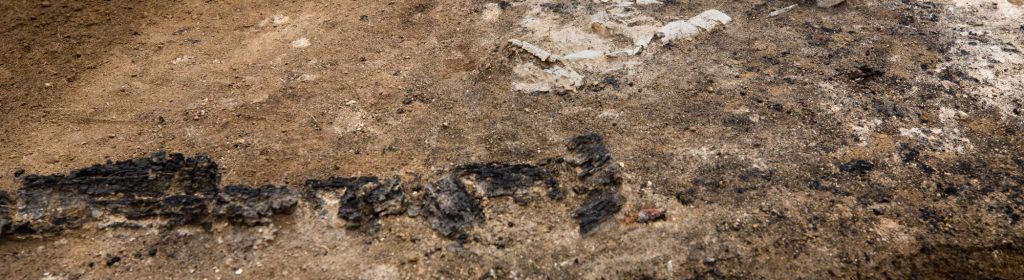
The 2021 campaign focused on uncovering and identifying cremation areas prior to this central pyre. Numerous items of furniture, generally burnt, are associated with this structure. The excavation of the AC16 cremation area, which is incomplete, will continue during a final campaign in the fall of 2022.
The work also involved continuing the study of glass artifacts that began several years ago. This involved both completing the inventory of items found up to the last study in 2018 and adding those from the excavations carried out between 2019 and 2021. A total of 2,245 fragments have now been inventoried, corresponding to a minimum of 275 individuals. The artifacts from zone A have been fully inventoried and analyzed. Those from enclosure 1F have been studied in great detail with a view to their forthcoming publication. They are mainly characterized by the presence of numerous melted balsamaria, either whole or in fragments. A few rare pieces of tableware and pots compete with the flasks. Items of jewelry and tokens have been identified, thus completing the metal and bone finds. Of particular note is the presence of an exceptional piece, an alabaster molded on a core. Interpretation remains difficult as the piece is melted and deformed. It could date back to the 2nd or 1st century BC. The main objective of this study is to trace funeral rituals through glass deposits. Indeed, different moments of use of these objects during the ceremony have been identified, revealed in particular by their location and state of preservation. A preliminary analysis of the remains from Marcus Tullius’ enclosure has also been undertaken. It appears that the glass fragments found so far correspond to a type of tableware that was common in the 1st century, but much more varied than the fairly homogeneous corpus of funerary deposits.