Direction
Aline Tenu (CNRS – UMR 7041 ArScAn)
How Eveha Participates
Topography
Archaeological investigations
Location
Iraq

The sixth excavation campaign at Kunara took place from September 18 to October 25, 2018. Work continued across the three lower-town areas opened in 2017.
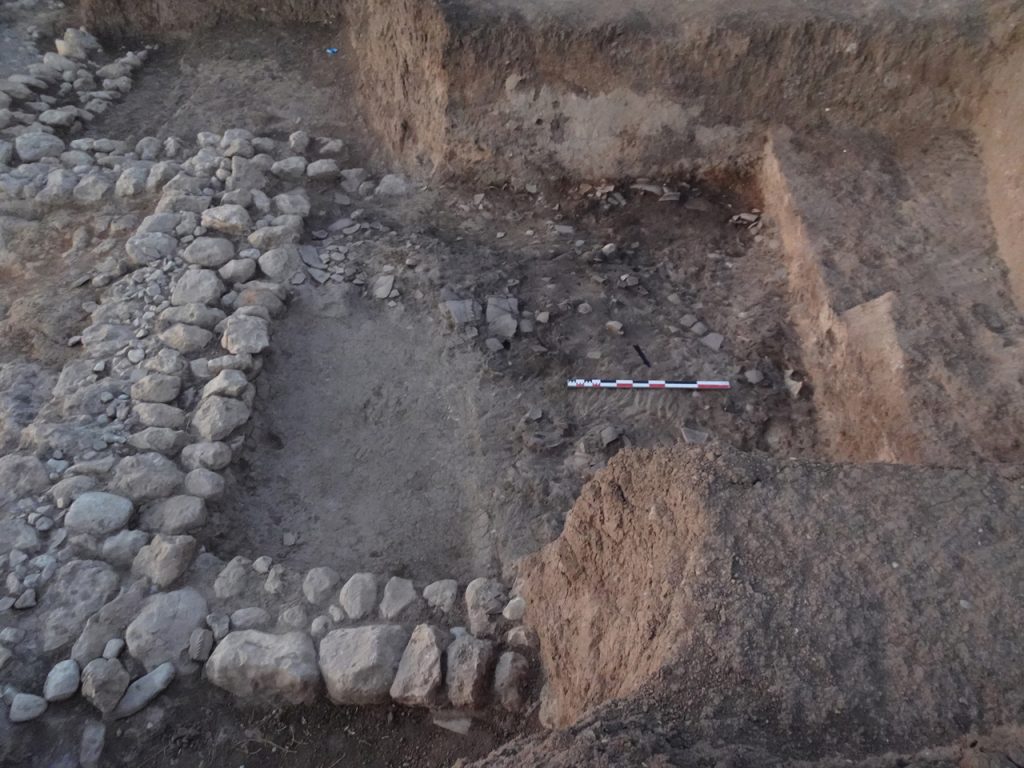
Area B Two sectors were explored in Area B. In the first, within the main building (B. 712), it was demonstrated that the rooms discovered to date surrounded a vast courtyard at least 27 m long. This courtyard was rich in potsherds and faunal remains, including those of a chicken—likely one of the oldest found in Iraq to date. Furthermore, traces of a violent fire were discovered in one of the rooms. The second sector, to the southeast, was established to begin the excavation of building B. 714. Its northern facade has been traced over a length of 15 m so far. The building was traversed by a stone drain.
Area C Excavations were concentrated on the western part of the area. The goal was both to complete the plan of building B. 517 and to study its integration into the urban layout. Two small rooms and a sort of kiln-fired brick annex were uncovered, while the northern room was fully mapped. The building was connected to a sophisticated network of drains. Once again this year, Area C yielded a very abundant collection of ceramic finds.
Area E The exploration of the monumental building B. 659, identified in 2015, began this year. Three rooms of just over 10 m² each were discovered. One of them yielded numerous potsherds and cuneiform tablets, which were unfortunately poorly preserved. In another room, a lion bone was unearthed. The earthen superstructure of the walls cleared during this campaign was preserved to a height of over 1 m, showcasing various construction techniques. The discovery of a second administrative archive in a building located in the northern part of the site, along with allochthonous material and a wide variety of wild species, confirms Kunara’s significant status and its integration into long-distance exchange networks.
Aline Tenu, CNRS Research Fellow, UMR 7041 ArScAn


(Mission archéologique du Peramagron)