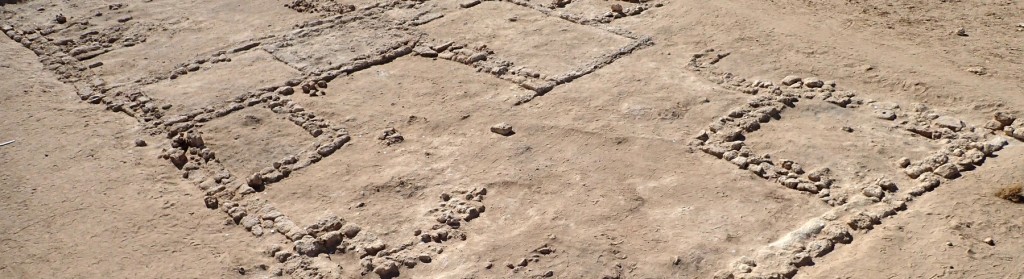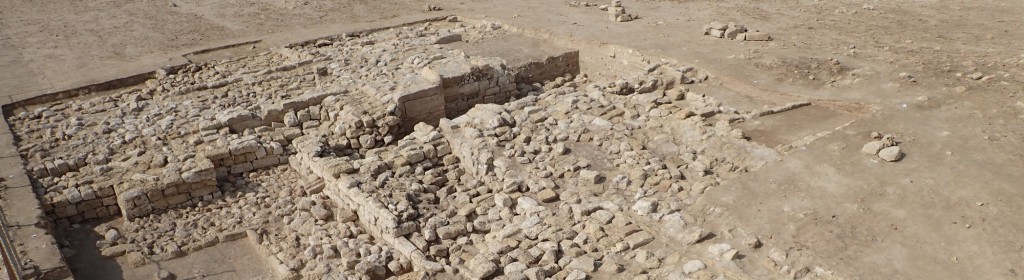
Éveha International is associated with the study of the site of Thâj in Saudi Arabia. This project is jointly led by the CNRS (UMR 7041 ArScAn), Leiden University (Netherlands), and the Saudi Commission for Tourism and National Heritage, with support from the Ministry of Foreign Affairs and International Development. It is co-directed by J. Rohmer (CNRS), A. al-Jallad (Leiden), and M. al-Hajiri (SCTH).
Direction
Jérôme Rohmer (CNRS, UMR 8167 Orient & Méditerranée)
Ahmad al-Jallad (Leiden University, Leiden Center for the Study of Ancient Arabia)
Mahmood al-Hajiri (Saudi Commission for Tourism and National Heritage)
How Eveha International Participates
Archaeological excavations
Localisation
Saudi Arabia
Location and Historical Summary
The site of Thâj is located in the modern-day Eastern Province of Saudi Arabia, 90 km from the Persian Gulf coast and the port of al-Jubayl. Its position at the crossroads of two major caravan routes made it a vital commercial hub between South Arabia, Mesopotamia, and the Gulf. Based on our current knowledge, Thâj is by far the largest settlement and the only true city known in Eastern Arabia during the pre-Islamic era.
The site consists of three parts :
• A vast fortified city of approximately 40 hectares, surrounded by an impressive defensive wall featuring corner towers and bastions.
• An extensive suburb stretching to the southeast over about 20 hectares.
• A large necropolis containing roughly 500 tumuli (burial mounds), some of which have yielded extremely rich artifacts.
Excavations conducted to date suggest a period of occupation spanning from the 3rd century BC to the 4th century AD. Given the chronology and importance of the site, several scholars have proposed identifying it as the ancient city of Gerrha. However, it could also be one of the other caravan powers of Eastern Arabia preserved in Greek and Arabian sources—notably through coinage. It is therefore a key site for understanding the settlement, culture, economy, and political landscape of Eastern Arabia, as well as the broader history of long-distance trade in the ancient Near East.
History of Research
The archaeological significance of Thâj was noted as early as the mid-19th century, but until recently, the site had only been subject to very limited excavations. Following the pioneering explorations of the Dicksons (1942) and Mandaville (1962/1963), the Danish expedition led by Bibby (1968) excavated two modest graves and conducted an initial $2 \times 2$ m stratigraphic sounding along the rampart, suggesting a “Hellenistic” dating for the site.
Fifteen years later, in 1983, an excavation campaign was carried out by a Saudi-German mission (Gazdar, Livingstone, and Potts), which notably refined the chronology of the site (3rd century BC – 1st/2nd century AD) and its fortifications (3rd/2nd century BC?). Finally, in 1998, a Saudi team from the Dammam Museum undertook a series of excavations on several tombs to the northeast and south of the site. Most notably, beneath a tumulus 40 m in diameter, they uncovered the aristocratic burial of a young girl, accompanied by exceptionally rich funerary items made of gold and precious stones.
To address the many remaining questions regarding the site (urbanism, material culture, cultural identity, political history, and economic role), a new five-year international excavation program was launched in 2016. This project is jointly led by the CNRS, Leiden University, and the Saudi Commission for Tourism and National Heritage, with the support of the French Ministry of Foreign Affairs. The first field campaign took place from October 25 to November 30, 2016, with a second season scheduled for autumn 2017.
Partenaires
Ministère des Affaires étrangères et du développement international
Saudi Commission for Tourism and National Heritage
CNRS, UMR 7041 ArScAn
Leiden University, Leiden Center for the Study of Ancient Arabia
Institut de Physique du Globe de Strasbourg
Project MEDEE (Mer, Désert, Environnement)
Centre français d’archéologie et de sciences sociales (CEFAS)