Direction
Louise Purdue (CNRS, CEPAM-UMR 7264, Nice Sophia Antipolis University, France)
How Eveha Participates
Malacology
Location
Sultanate of Oman and United Arab Emirates

The field campaign in the Masafi Oasis (Emirate of Fujairah) took place between November and December 2016. The collaborator from Eveha International, a geoarchaeologist specializing in malacology, participated in this mission to acquire the project’s baseline reference data.
The objectives were to:
- Survey the various microenvironments/micro-habitats present in the study area;
- Implement an appropriate reference sampling protocol;
- Collect malacological fauna from the previously determined stations.
During this December 2016 campaign, the malacologist first conducted a survey of the various biotopes and microenvironments within the oasis and its surroundings. Following this, a specialized sampling protocol was established to address issues related to environmental and agropastoral transitions at the site. Ultimately, this preparation allowed for the creation of a reference collection of malacological assemblages present within and around the Masafi palm grove. This baseline will be used to compare current fauna with subfossil assemblages acquired during previous campaigns and those to be collected in the future.
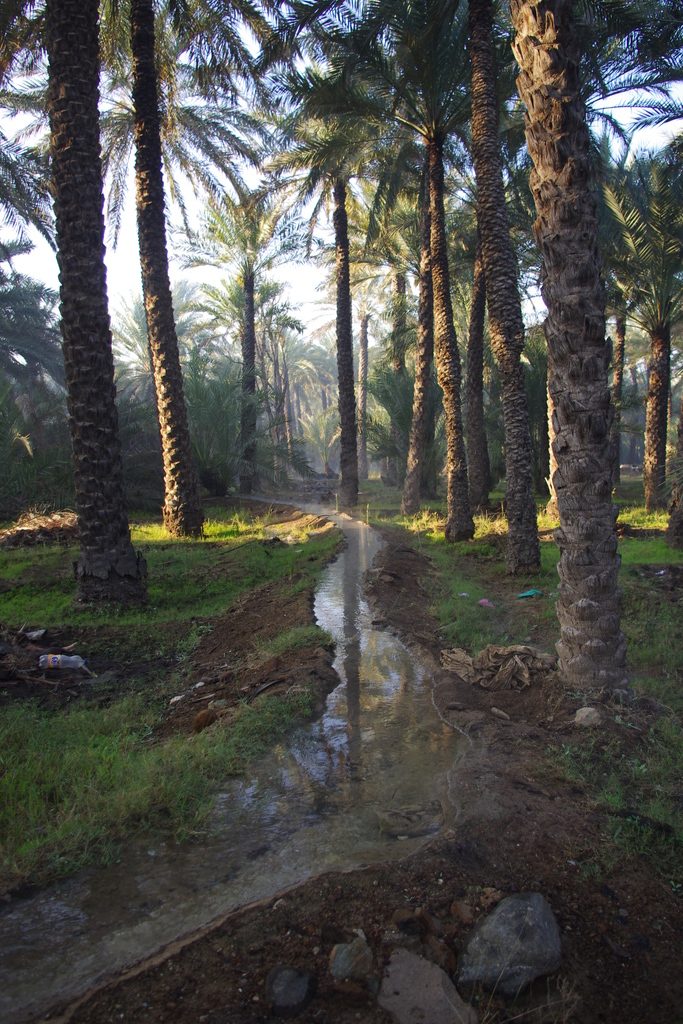
Each micro-habitat composing the palm grove and its vicinity was subject to a collection of its modern malacological fauna for characterization purposes: abandoned agricultural spaces; areas densely vegetated by trees and legumes; sparsely covered palm groves; manured/amended surfaces; fruit-growing agricultural areas; areas with slash-and-burn activity; agricultural zones with spreading of carbonate cleaning backfill; irrigation canal beds; sediments from artesian mounds; wadi beds in fine accumulation zones; and finally, upstream wadi catchments in hillslope contexts.
Next, a portion of the malacological fauna was extracted from the sediments through wet sieving (10 liters per layer) using a sieve column with decreasing mesh sizes of 2 mm and 1 mm. After drying, the samples were sorted under a magnifying glass to extract all identifiable shells. When necessary, for the smallest taxa, identification was performed using a binocular microscope at 2x to 4x magnification. The quantification of taxa results from the counting of identifiable adult and juvenile individuals.
The reference collection, currently being compiled during the December 2016 Masafi mission, will be utilized in future missions to meet the objectives set by the ANR OASIWAT project.