Direction
Loïc Mazou (Éveha, UR 15071 HeRMA /
UMR 7041 ArScAn)
Pascale Ballet (UMR 7041 ArScAn)
Patrice Georges-Zimmermann (Inrap/
UMR 5608 TRACES)
How Eveha Participates
Mission Direction
Location
Egypt
du secteur (P. Georges-Zimmermann, M. Gaber).
© Ifao/Paris Nanterre.
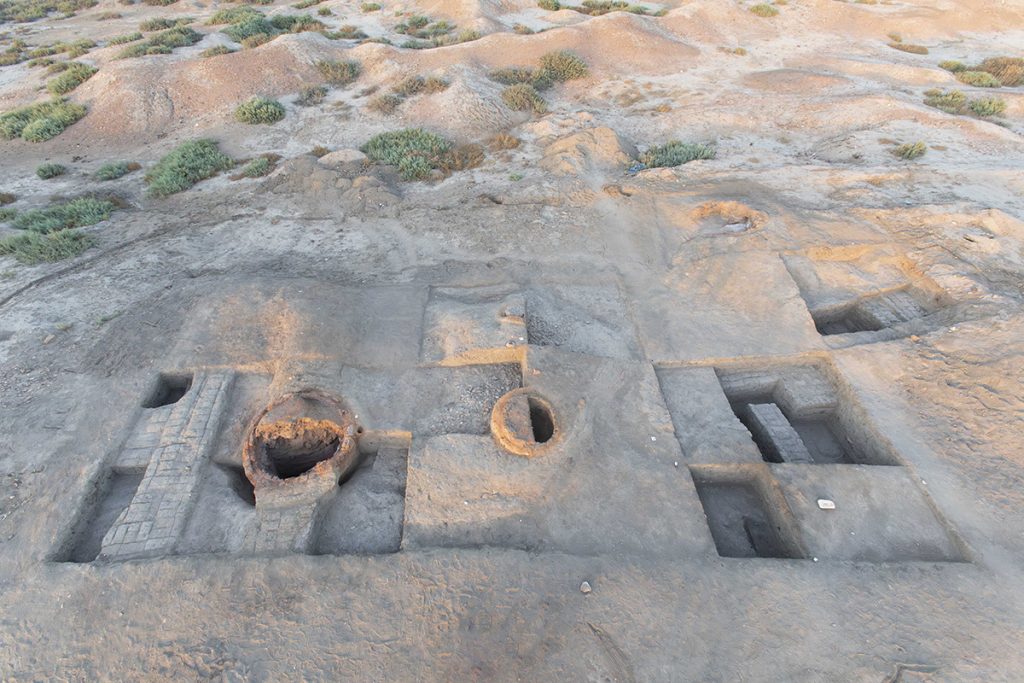
The French Mission to Bouto (MfB), led by Loïc Mazou, Pascale Ballet and Patrice Georges-Zimmermann, took place in two phases (May 7 – June 6 and October 17 – November 1, 2024). This mission is part of a program to study the urban occupation of Bouto in the Imperial Roman period (from Octavian to Diocletian) from three fundamental angles: housing, production activities and funerary practices. The 2024 campaign focused on the western necropolis (sector P22) and the area of potters’ workshops (sector P23).
Work in the necropolis was carried out in three different zones (P22-3, P22-4 and P22-5), revealing a complex stratigraphy that bears witness to several phases of occupation of the site:
The western necropolis (sector P22)
Late Period occupation
The earliest levels correspond to a Late Period settlement. Ceramological study of these layers revealed a domestic corpus composed mainly of local alluvial paste ceramics (“sausage jars”, bottles, bowls, etc.) and a significant quantity of imports (around 25% of the finds). The latter include amphorae from Chios, Asia Minor (Lesbos, Clazomenes) and the Levant, testifying to Bouto’s integration into Mediterranean trade networks.
Ptolemaic phase
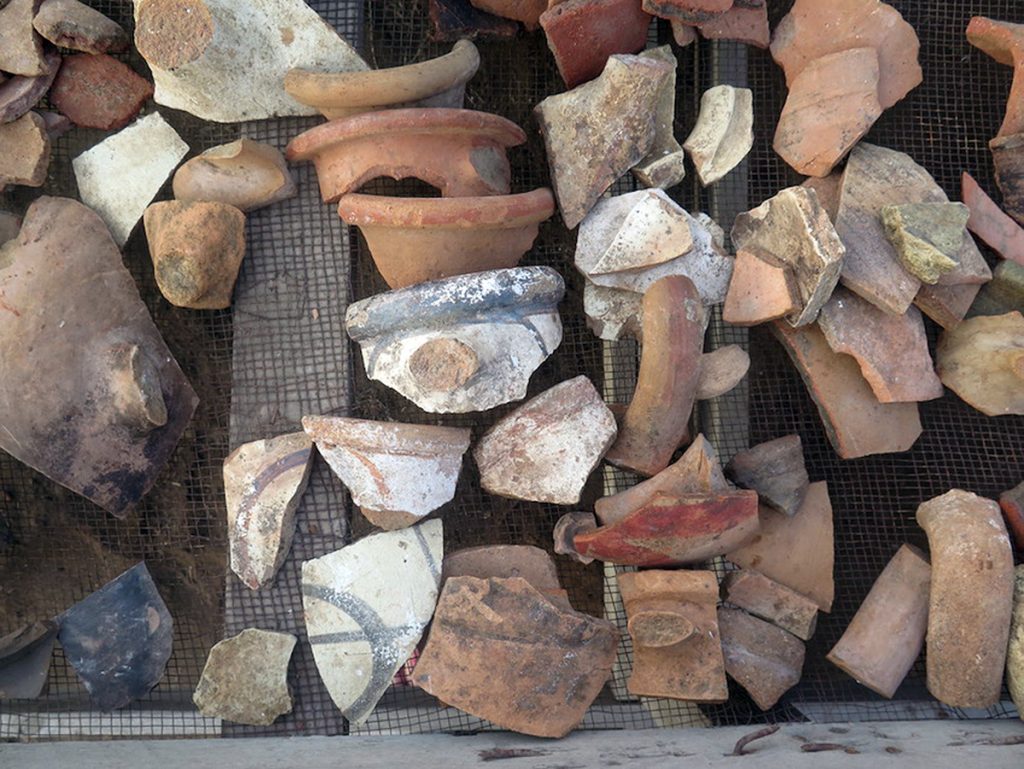
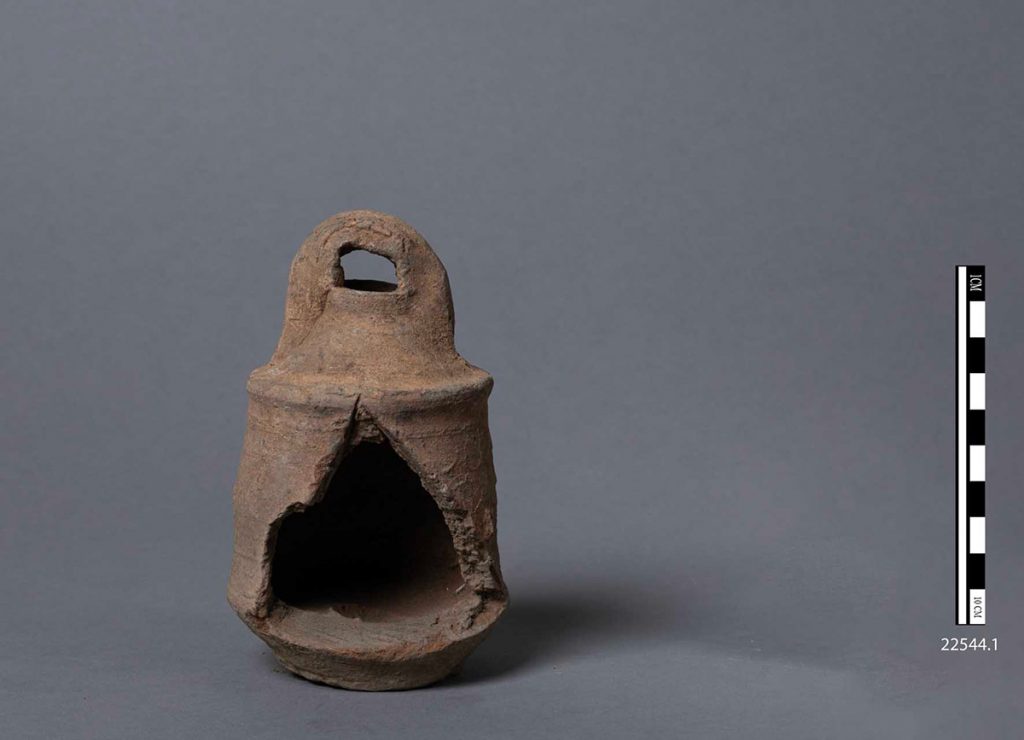
In zone P22-3, excavation of a kiln dating from the Middle Ptolemaic period (late 3rd – early/mid 2nd century BC) revealed a range of ceramics including hemispherical bowls, carinated bowls, cylindrical beakers and cooking pots. One particular object was discovered: a terracotta lantern shaped by throwing
Roman necropolis
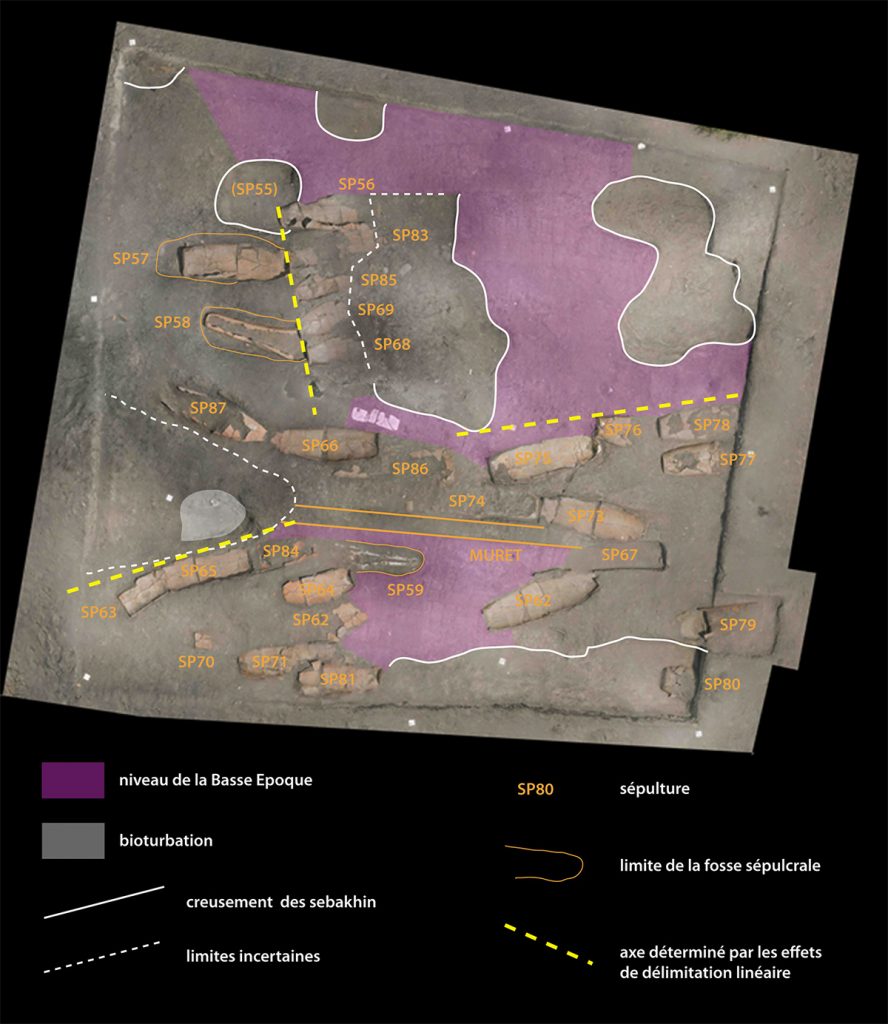
Zone P22-4 (approx. 100 m²) yielded 30 burials from the Roman period (1st-2nd centuries AD). The deceased were generally buried in containers consisting of two jars placed end-to-end. Two particular cases have been identified: a burial using an upturned sarcophagus vat as a cover (the bottom is not constructed), the first example of reuse of a container that we have encountered, and an immature burial where a jar was supplemented by ceramic to protect the legs and feet.
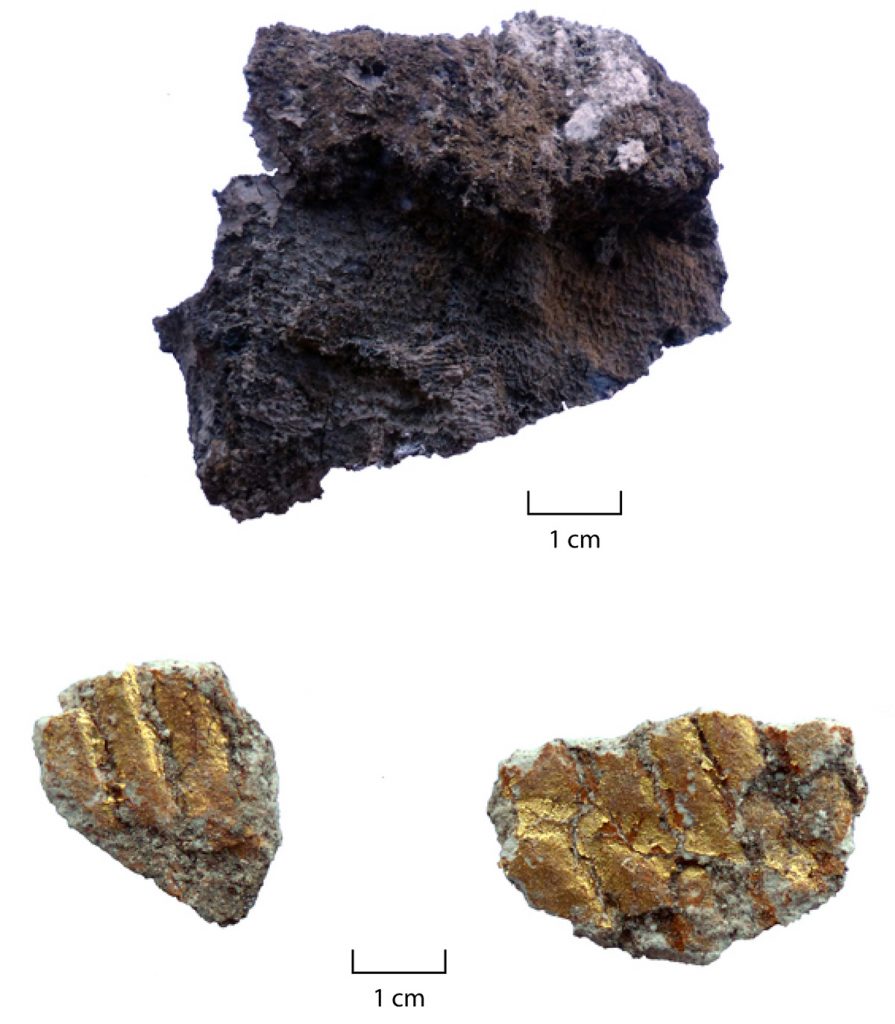
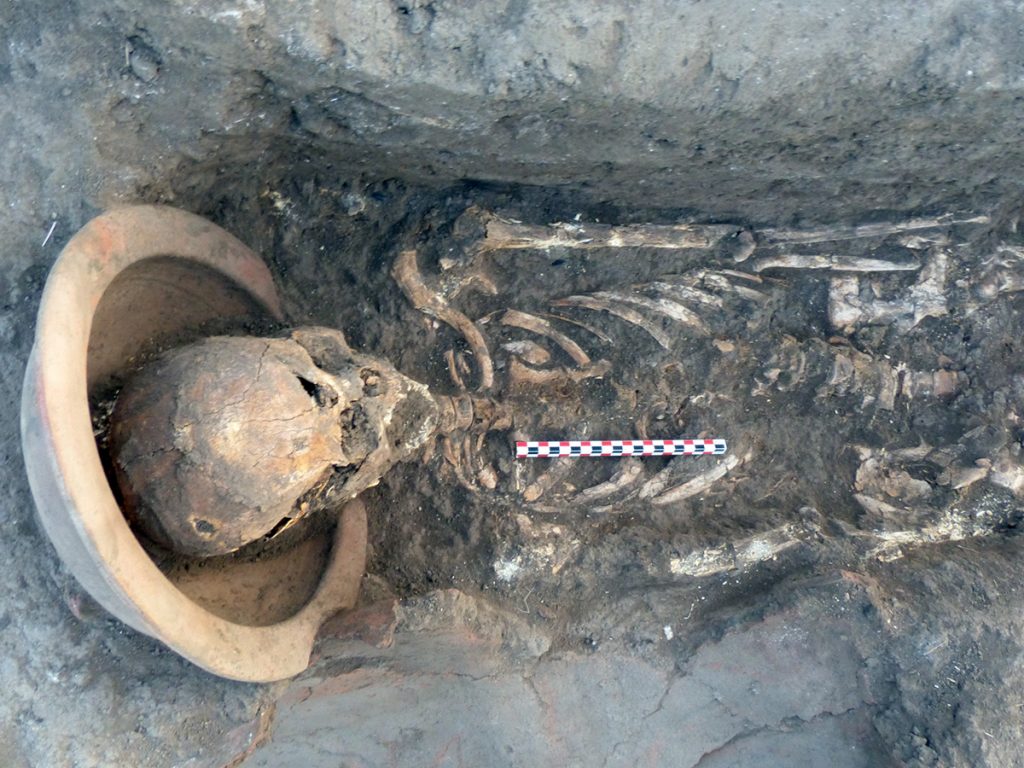
An archaeothanatological study of the burials revealed signs of mummification (traces of cloth, plaster and gold leaf) and anomalies in the position of the bones, suggesting that they had been removed (looted). An unusual feature was also observed in one of the burials: a deep dish of Fine Rouge Roman ceramics placed behind the head of the deceased, creating a kind of nimbus or protective halo.
Potters’ workshops (sector P23)
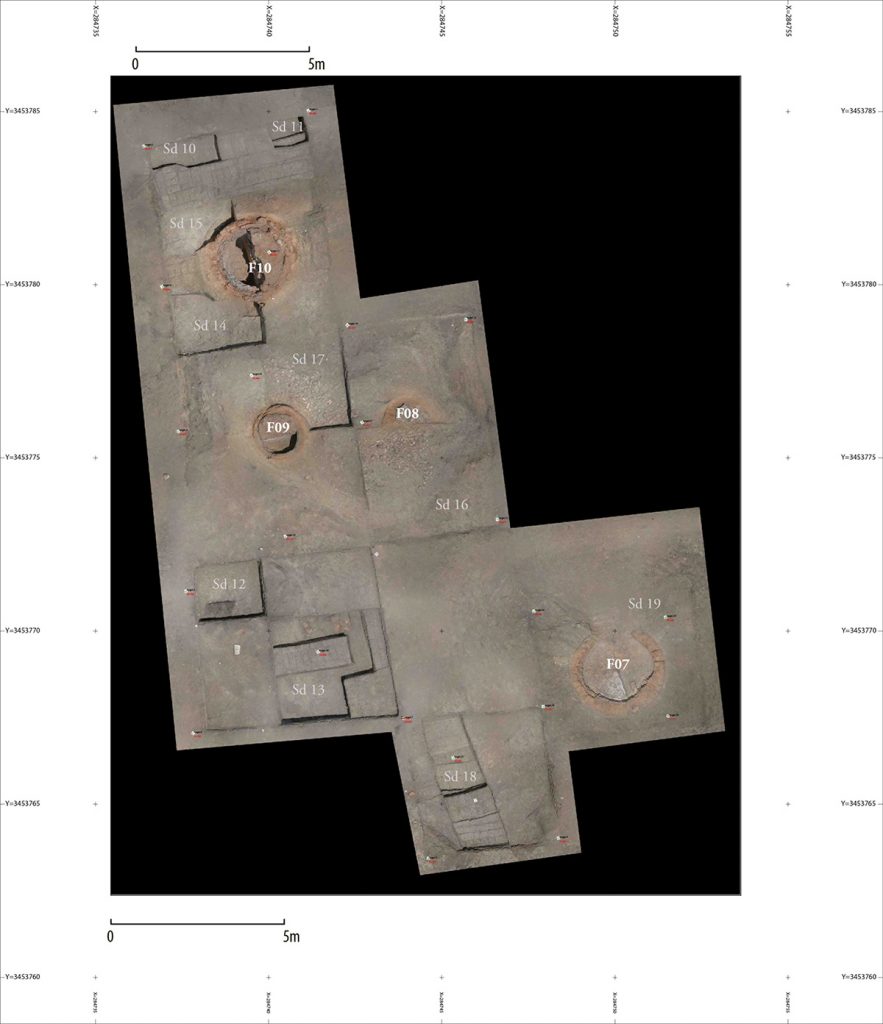
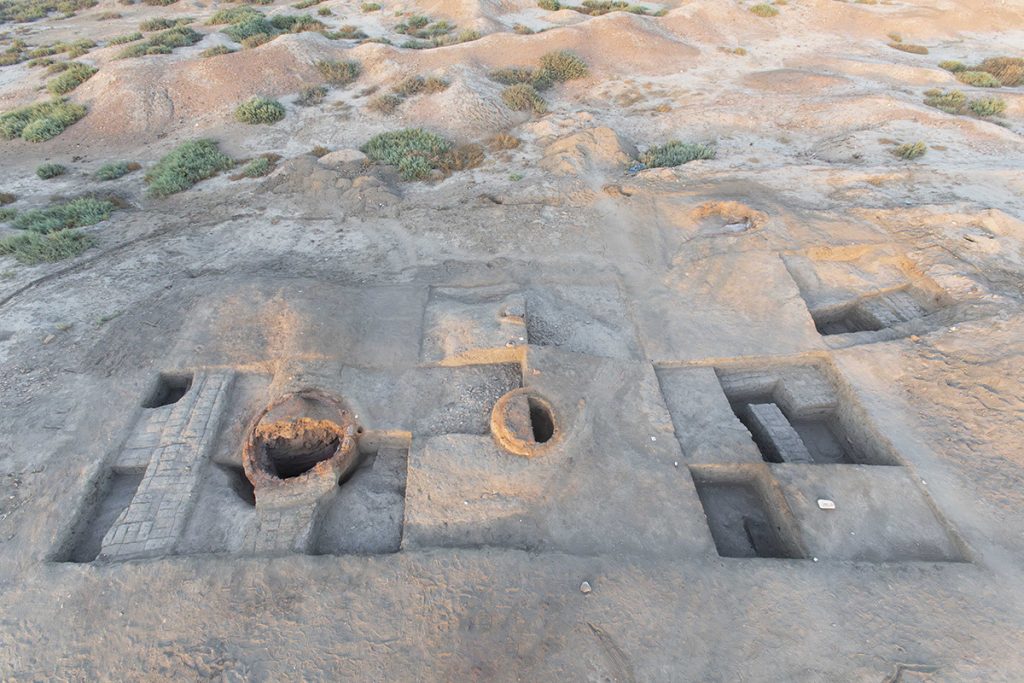
Excavation of this sector enabled further study of a group of 10 Roman-period potters’ kilns and an understanding of their environment.
Phases of occupation
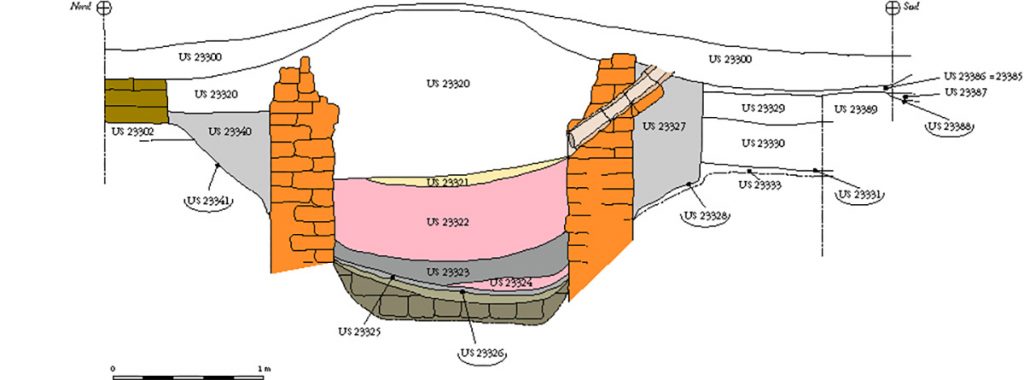
The stratigraphic study revealed that the Early Roman potters’ workshops (mid 1st – early 2nd century AD) were built on the remains of Late Roman and Ptolemaic settlements. The large mud-brick walls dating from the Late Period served as a foundation for the kilns, ensuring stability and solidity for the firing structures.
Furnace architecture and technology
Four new furnaces (F07 to F10) were studied in the northern part of the sector. Furnaces F07 and F10, the largest (2.80 m and 2.50 m in diameter), feature a pipe ventilation system with interlocking amphora necks. Furnaces F08 and F09, smaller (1.60 m diameter) and less well preserved, reflect a technological simplification that could indicate a decline in production. The various contexts directly associated with kilns F07 and F10 contain few elements of the sector’s production, due to the significant levelling of these structures and the poor preservation of the filling or abandonment layers. However, they do contain pipes used for firing in mode C (complete oxidation phase), or possibly used as ventilation ducts in the firing chamber. This indicates a relative technical standardization of kilns throughout the area, which probably alternated between C-mode firing and A-mode firing (cycle: reduction, reduction, oxidation).
Further ceramic studies
A study of Ptolemaic tableware from sector P16 has revealed local production imitating Greek forms, notably two-handled bowls inspired by skyphoi. These imitations testify to the adoption of Mediterranean models in Egyptian material culture.
Conclusion and outlook
The 2024 campaign has enabled us to gain a deeper understanding of two major components of the ancient city: craft production and funerary practices. The research shows an intensely occupied area from the Late Period to the Roman period, with a transition that seems to have taken place without any major break. The chronological and spatial coherence between the artisanal and funerary sectors remains to be clarified.
In the coming campaigns, the emphasis will be on exploring the central zone of Kom A, where vestiges of mud-brick architecture could indicate the presence of an Imperial-period residential area, thus enabling us to tackle the third part of the program (“Living”).
Bouto’s mission represents an important contribution to our understanding of the evolution of cities in the Nile Delta at the transition between the Pharaonic, Hellenistic and Roman periods, shedding light on the economic, cultural and social dynamics of the region.
© Ifao/Paris Nanterre.Fig. 3 : Secteur P22. Lanterne, Inv. n° P22/22544.01. Production probable du four ptolémaïque.
(I. Mohamed Ibrahim). © Ifao/Paris Nanterre.
(P. Georges-Zimmermann). © Ifao/Paris Nanterre.
(M. Gaber). © Ifao/Paris Nanterre.
© Ifao/Paris Nanterre.
© Ifao/Paris Nanterre.
(I. Mohamed Ibrahim). © Ifao/Paris Nanterre.