Direction
Vincent Francigny (CNRS, UMR 8167 Orient & Méditerranée)
Participation d’Éveha
Fouilles archéologiques & post-fouille
Location
Sudan

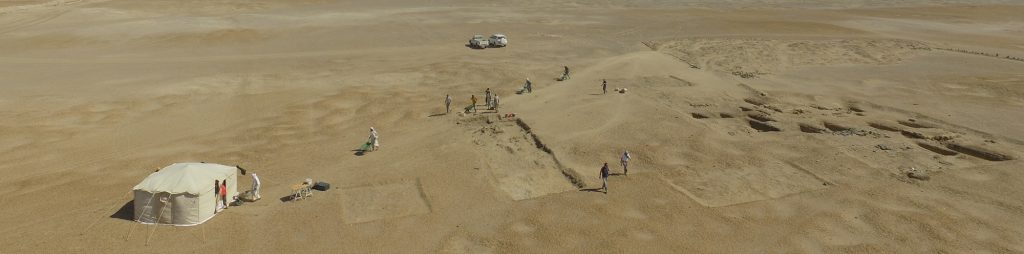
The 2022 campaign took place from November 4 to December 2 under the direction of Vincent Francigny (CNRS, UMR 8164 – Sorbonne University). Work focused on necropolis 8-B-52-B, on the northwestern sector of the fortified city, and on the protection and enhancement of the island’s archaeological sites.
The Meroitic necropolis 8-B-52-B
One of the objectives of the mission was to continue the excavation of one of the necropolises from the Meroitic period (3rd century BC – 3rd century AD).
Located on a slight hill in the northern sector of the island, a few hundred meters west of the Pharaonic city, necropolis 8-B-52-B was identified in 1996 and was the subject of brief excavation campaigns at the time. Investigations resumed there in 2018, following the complete excavation of another complementary necropolis (8-B-5-A) located 400 meters northeast of 8-B-52-B. These two cemeteries may have been occupied simultaneously. They appear to have been occupied for several centuries, and the funerary structures were regularly reused throughout the Meroitic period and even into the Christian era in the case of 8-B-5-A. Their joint excavation will, once the study is complete, make it possible to determine their relative chronology. In particular, the aim is to understand what could justify the establishment of two separate elite burial complexes in an area where space constraints are low.
The adult burials are oriented east to west. Their burial chambers take the form of oblong cavities dug into the substrate, on average more than one meter below the surface. They are closed by a wall of unfired bricks and preceded, to the east, by an open-air access forming a slope from the ground to the entrance of the cavity. These burials are often collective, as the closing wall can be dismantled and reassembled for new burials. The tombs are sometimes topped with pyramids, most often built of mud bricks. These pyramids are associated with funeral chapels. The superstructures are generally very flattened or completely destroyed. Children’s tombs are most often simple pits dug into the ground along the walls of the pyramids. Meroitic burials were often looted during Antiquity, in Sai as in the rest of Sudan.
One of the specific features of these two necropolises is the excellent preservation of the human remains. Despite the looting, there are many complete individuals, some of whom have been naturally mummified. An anthropological study, which also includes human remains from previous excavations, is being conducted by Tosha Dupras (Texas Tech University) and Yann Ardagna (Aix-Marseille University – UMR 7268).
During the 2022 season, more than 40 burials were excavated and documented in a 500 m² area extending northward and into the heart of the necropolis. Several pyramids and a few pits for extracting raw materials (probably intended for the manufacture of bricks or mortar) were identified. The tombs generally follow the same layout, with a west-facing burial chamber, except in the northeast sector, where several of them have two burial chambers: one to the west and one to the east, both accessed via the same shaft. A few smaller tombs have a side chamber to the north or south of the shaft.
The tombs located in the center of the cemetery, on a slight hill, are larger than those dug at the northern and eastern ends of the excavation. One of these large tombs yielded a funerary stele inscribed in cursive Meroitic script from its upper filling. This script was used between the 3rd century BC and the 5th century AD. Deciphered since the early 20th century, it has not yet been fully translated and represents a corpus of approximately 2,500 inscriptions.
A burial in one of the neighboring tombs escaped looting and yielded a complete burial, complete with its furnishings: locally painted ceramic jars, imported glass and metal vessels, and a cylindrical wooden kohl pot with ivory inlays. These precious objects bear witness to the wealth of the communities living on the island and to long-distance trade with the Mediterranean world.
The urban sector: Pharaonic and medieval structures
An excavation window has been opened in the northwestern sector of the ancient city. This city, which covers more than four hectares, has been the subject of various excavations and spot surveys since the 1950s and is mainly known for its Pharaonic occupation. During the New Kingdom, Saï was an Egyptian colony and an urban center developed in the northern part of the island. Recent excavation campaigns have identified the large mud-brick enclosure that marks the northern boundary of the city. In 2022, an area marked by redevelopment attributed to the medieval period was explored. Time constraints prevented an exhaustive excavation, but preliminary results suggest a craft district with several combustion structures. The initial findings of the ceramic study point to the Christian period, while some buildings seem to be part of the Pharaonic network. This sector will be fully excavated during the 2023 campaign, which should enable the identification of the different phases of occupation and the functions of these spaces.
Furniture and architecture studies
This season, the mission welcomed several partners whose skills and areas of research complement those of the team.
As part of the ERC Fashioning Sudan. Archaeology of dress along the Middle Nile [https://fashioningsudan.ku.dk/], Elsa Yvanez (University of Copenhagen) joined the mission to study leather and fabric clothing from the excavation of Meroitic necropolises found in situ on naturally mummified bodies.
David Gandreau and Nadia Licitra (CRAterre/AE&CC/ENSAG/UGA) carried out an assessment of the processes and circumstances of degradation of the earthen architectural remains on the island, as well as a series of field tests on mud bricks from various monuments on the island. This research is part of the ANR Nile’s Earth project [ANR-21-CE27-0019-01, https://nilesearth.hypotheses.org/le-projet] led by the École nationale supérieure d’architecture de Grenoble, whose objective is to better characterize and preserve the earthen heritage of the ancient Nile Valley.
Training
Several French students (Sorbonne, EPHE, ENS Lyon), whose master’s or doctoral research topics are directly related to the archaeology and history of the island of Saï, participated in the mission. They were trained in fieldwork and had direct access to the material they are studying, in particular ceramics and small furniture.
Protection and enhancement of the island’s archaeological sites
Part of the activity was devoted to the protection and enhancement of the island’s numerous archaeological sites. Recent years have seen a significant increase in looting, likely linked to the intensive activity of gold prospectors in the region. This damage is concentrated in the island’s necropolises and affects both previously undiscovered monuments and structures that had been excavated and then filled in.
Several recently constructed protective ditches have been maintained to prevent motorized vehicles from accessing sensitive areas. Major cleaning and backfilling work has been carried out in various areas of the island, particularly for safety reasons, as the holes left by looters can be several meters deep.
Mediation and dissemination of knowledge
For several years, conferences have been organized in the island’s villages to inform residents about the archaeological heritage and the work carried out by the mission. This year, several hundred educational booklets on the archaeology of Sudan, published as part of the Sudan Archaeological Heritage Protection Project, with the support of the French Section of Sudanese Antiquities (SFDAS), were distributed in local schools.