Direction
Tony Silvino (Éveha – UMR 5138, Archéologie et Archéométrie)
Pedro Pereira (CITCEM – Université de Porto)
How Eveha Participates
Archaeological investigations
Management
Location
Portugal

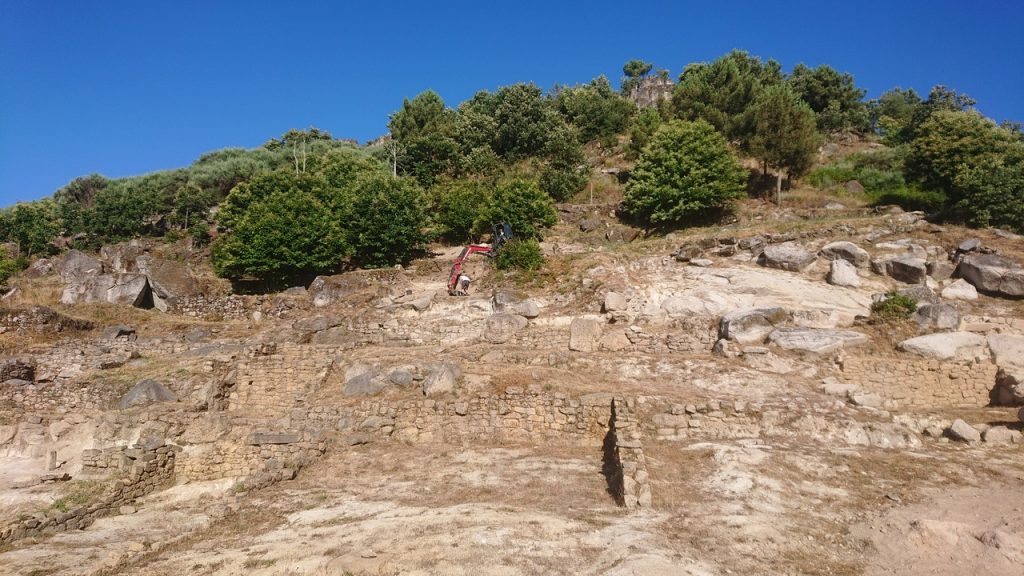
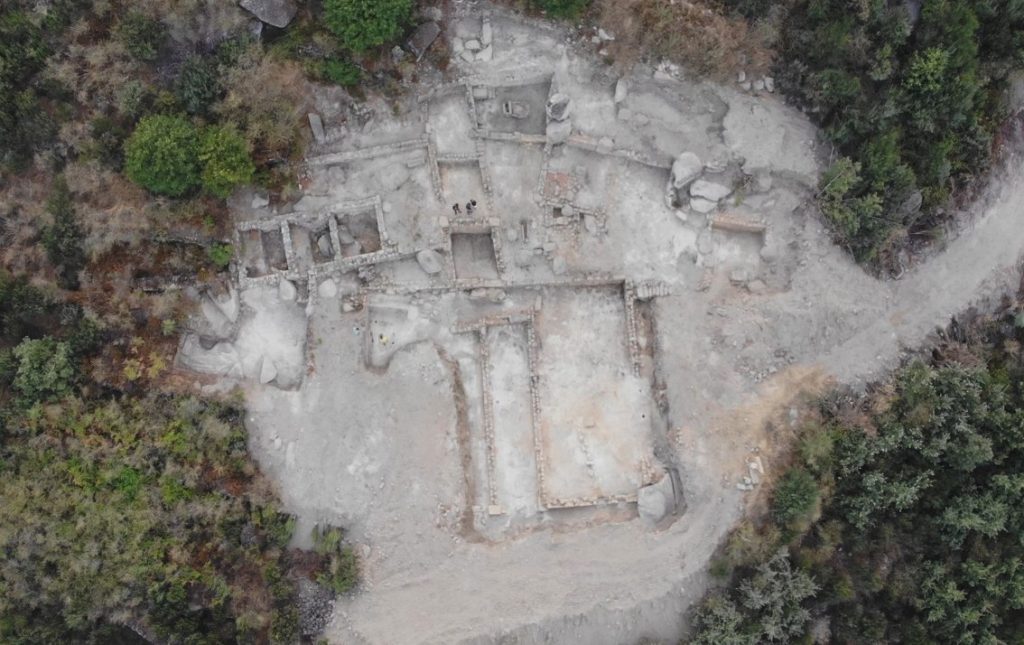
The Trás do Castelo site in Vale de Mir – Pegarinhos (Portugal) is located in the Douro Valley, on the edge of a granite plateau. Numerous campaigns carried out at this site since 2012 have revealed an agricultural settlement established at the end of the 1st century AD and abandoned in the second half of the 3rd century. The remains uncovered relate to a rural farm combining different types of activities: livestock farming, grain processing, textile production (probably linen) and wine production. The latter remains unique in this region, straddling two provinces (Tarraconensis and Lusitania), as it is the oldest proven evidence in the Douro Valley. It was probably the economic part of a villa-type establishment. The site was reoccupied during the 4th century, either by reusing certain areas of the old farm or by creating new, rather crude buildings. One of the peculiarities of this occupation is the discovery of five small coin deposits that can be interpreted as purses. Traces of older occupations have also been observed. These include a large terrace wall dating from the 4th-3rd centuries BC, associated with ceramic furniture. Similarly, the discovery of a Palmela-type bronze arrowhead attests to the presence of a Chalcolithic settlement in the vicinity of the site.
Despite the risk of fire and the July heat, which severely hampered the progress of the excavation, the 2022 campaign nevertheless made it possible to uncover an additional area of late antique occupation equipped with hearths and a buried dolium, associated with a large coin hoard dating from the early 5th century. This adjoining space, built on a granite slope, was associated with another room, the surface stripping of which revealed not only another coin hoard but also a whole series of iron and copper alloy objects: large keys, a knife, blacksmith’s tongs, scales, ingots, etc. Numerous batches of ceramics, particularly dolia, were found on the surface of this space. The discovery of decorative objects should also be noted. The presence of other artifacts of this type has been confirmed in the demolition levels and the charcoal-covered floor level of the room. All of this currency (approximately 1,400 coins, more than 80% of which are imitations) is associated with other objects, such as the Roman scales, ingots, and tongs. This assortment leaves us perplexed: was it a counterfeiters’ workshop or a metal reserve awaiting recycling? The question remains open. The next campaign will involve completing the excavation of this space and gaining a better understanding of its exact purpose(s). In any case, these discoveries further confirm this site as a major archaeological deposit in the Douro Valley.