Direction
Jérôme Rohmer (CNRS, UMR 7041 ArScAn)
Ahmad al-Jallad (Leiden University, Leiden Center for the Study of Ancient Arabia)
Mahmood al-Hajiri (Saudi Commission for Tourism and National Heritage)
How Eveha Participates
Archaeological excavations
Location
Saudi Arabia

In 2018, the archaeological mission at Thaj focused on different areas.
Most of Éveha International’s participation concentrated on the southeast gate of Thaj, under the leadership of Damien Gazagne.
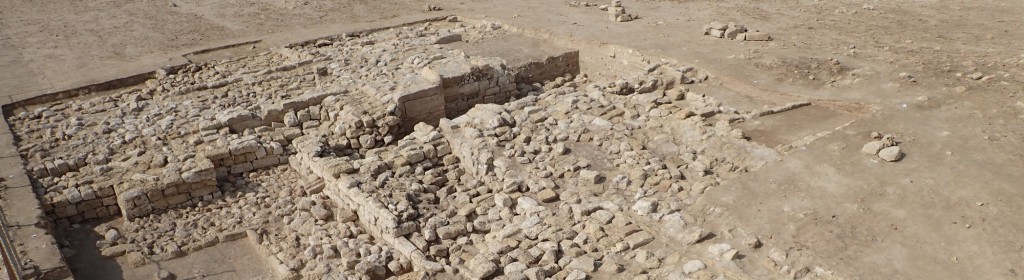
Fieldwork uncovered the defensive system of one of the city’s entrance gates, covering an area of 500 m². The stratigraphic sequence reaches a depth of 2.5 meters and has made it possible to document the late phases, from the 4th to the 13th century AD.
At the end of the unrest in the region, at the beginning of the 4th century AD, the gate, which had been blocked, was reopened and a traffic route was reestablished. The area was occupied until the mid-7th century and was finally abandoned at that time. Only a medieval cemetery occupied part of the space at a much later date.
Inside the ramparts, a district of the city continued to be explored by a Saudi team.
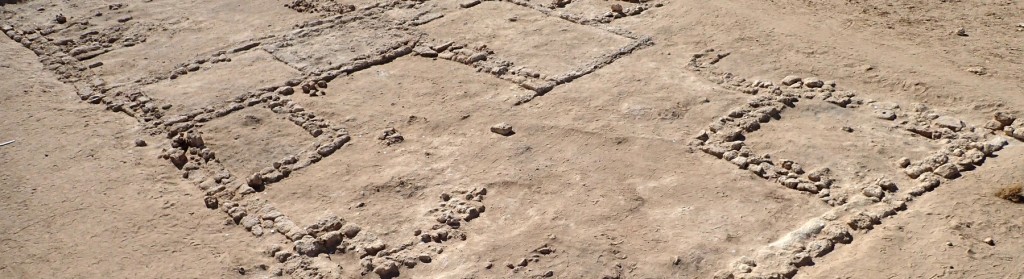
Outside, a suburb that had already been partially explored in previous years was the subject of further investigation. This focused on craft sectors—pottery workshops in particular—but also revealed the early phases of occupation of the area, characterized by the presence of a monumental building constructed of carefully cut and fitted large stones.
In the southern necropolis, several funerary monuments were excavated, including large tumuli or “white circles.” In some cases, the skeletons were still present, but the majority of the tombs appear to have been looted.
Finally, in the northern part of the city, geophysical surveys combined with the digging of a few mechanical trenches have provided a new perspective on this part of ancient Thâj, which appears to have been very sparsely urbanized.