Direction
Laïla Nehmé (CNRS – UMR 8167 Orient & Méditerranée)
Daifallah Al-Tahli (University of Hail, Saudi Arabia)
François Villeneuve (University of Paris 1 Panthéon-Sorbonne- UMR 7041 ArScAn)
How Eveha Participates
Archaeological excavations
Location
Saudi Arabia

Excavation of the Urban Sanctuary of Hegra
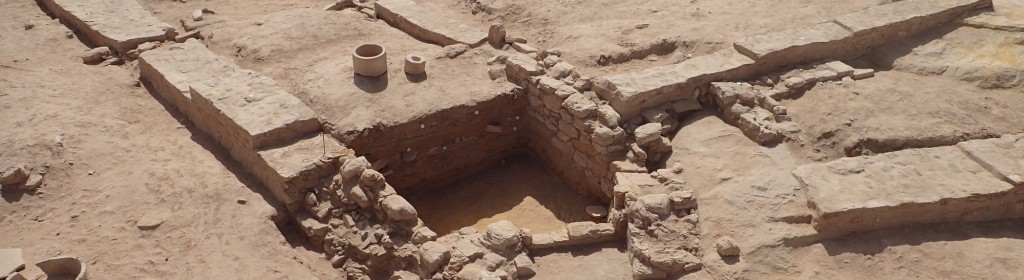
The participation of Damien Gazagne, from Éveha International, in the excavation of the urban sanctuary of Hegra continued in early 2020. The fieldwork enabled the further study of the sanctuary, which was occupied between the 1st and the early 5th century AD.
The first phase (Nabataean) saw the construction of a sacred high place associated with a lower terrace surrounded by a temenos wall. This phase shows comparative elements with South Arabian sanctuaries, notably the rooms built along the periphery of the temenos wall.
The second phase (Roman) is characterized by the transformation, in whole or in part, of the lower terrace into a place of worship for the garrison. New peripheral rooms were created, likely serving as chapels. These were dedicated to deities such as Jupiter of Damascus—mentioned in an inscription discovered this year—who were worshipped by the soldiers. The sanctuary now featured two entrances, formally identified during this campaign: the main entrance, to the west, provided access to the tetrapylon located at the top of the rocky outcrop, forming a type of high place. It was likely dedicated to the main deity of the sanctuary, possibly the “God of the Heavens” mentioned in an inscription. The secondary entrance, located to the north, opened onto the lower terrace, which was dedicated, at least in part, to other divinities.
At the end of the Roman period, the lower terrace of the sanctuary was repurposed as a craft and industrial zone. The temenos wall was partially dismantled to facilitate access to what may have been an oil mill, a series of kilns, and a house built within the sanctuary courtyard.