
Direction
Abdallah Fili (El Jadida University)
Ronald Messier (Middle State University/Vanderbilt University)
Chloé Capel (CNRS, UMR 7041, Arscan)
How Eveha Participates
Topography
Location
Morocco
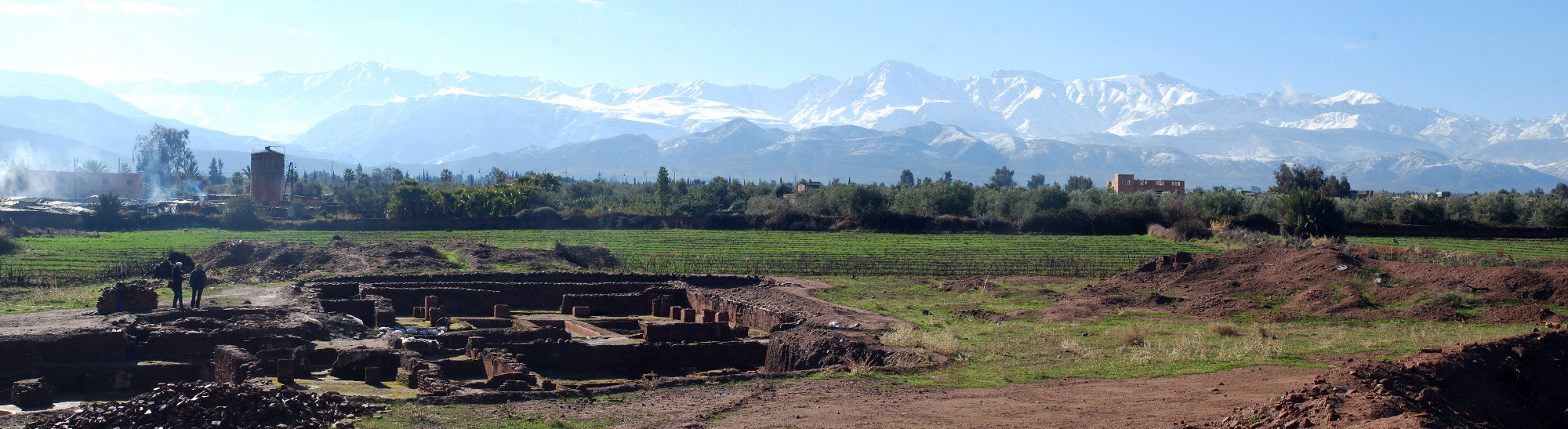
(© mission archéologique d’Aghmat)
This text provides a fascinating overview of the 2018 rescue excavations at Aghmat, highlighting the discovery of elite medieval domestic architecture.
Here is the English translation, using standard archaeological and architectural terminology:
In February 2018, a two-week rescue excavation campaign was organized at the site of Aghmat. This intervention was prompted by a construction project initiated by the Ministry of Culture and Information—through the Directorate of Cultural Heritage and the Marrakech-Safi Regional Directorate of Culture—to build a new facility for archaeologists and visitors in the heart of the ancient medieval city.
The existence of a sumptuously appointed residence at this location had been revealed during the previous campaign in autumn 2017, when only a limited surface area could be explored. The expansion of the excavation area now allows for a more precise understanding of this quarter’s layout.
Following a general mechanical stripping (de-turfing/clearing), the excavations covered an area of nearly 1,000 m².
At least two wealthy domestic units are now documented in this sector. Each features an open-air courtyard housing a basin (pool) flanked by gardens. Reception areas occupy the shorter sides of the courtyard, while functional rooms—such as latrines and kitchens—complete the complex. A third dwelling of the same type may also be present. These buildings, which follow a fairly regular plan, were constructed between the late 13th and early 14th centuries, based on ceramic evidence (traces of an older occupation appeared within a deep test pit conducted in 2017).
Starting in the 14th century, certain modifications were made. In one of the residences, the courtyard was embellished with a border of zellij—polychrome glazed tiles—forming geometric patterns. These are the first zellij tiles found in situ at the Aghmat site.
The construction of a wide road bordering some of the houses on their northern flank dates back to the 14th century at the latest. The pavement, over 3 meters wide, is entirely covered with carefully arranged flagstones—an exceptional type of infrastructure for this period.
Subsequently, the domestic complexes appear to have undergone radical transformations: certain entrances were blocked, walls were razed, and numerous signs of intense domestic activity were identified, including kilns, latrines, hearths, and middens (refuse pits). These changes seem to indicate a shift in the occupants’ social status. Occupation appears to have persisted beyond the first half of the 14th century, contradicting the long-held belief that Aghmat was largely deserted by the middle of that century. Generally speaking, the excavation of this quarter suggests a significantly later date for the abandonment—or at least the decline—of the city of Aghmat, as the roadway appears to have been maintained until at least the 15th century.
The site is also dotted with massive, sometimes very recent, pits linked to the robbing of construction materials; in some places, only fragments of walls remain.
Finally, it should be noted that the plan of the residences uncovered in this sector is closely related to that of the “palace” identified in 2008. This confirms the wealth of the medieval city of Aghmat, where high-status housing clearly played a major role.


