Direction
Jérôme Rohmer (CNRS, UMR 7041 ArScAn)
Ahmad al-Jallad (Leiden University, Leiden Center for the Study of Ancient Arabia)
Mahmood al-Hajiri (Saudi Commission for Tourism and National Heritage)
How Eveha Participates
Archaeological excavations
Location
Saudi Arabia

The second campaign of the Franco-Dutch-Saudi mission at Thâj took place from late October to early December 2017. Operations initiated in 2016—including geomagnetic surveys, archaeological and epigraphic surveys, and excavations in Sectors 1 and 2—continued, while several new excavation areas were launched:
- Sector 3: Excavation of a funerary platform containing at least three cists (stone-lined graves);
- Sector 4: Excavation of a large tumulus measuring 50 m in diameter;
- Sector 5: Excavation of a funerary enclosure;
- Sector 6: Excavation of a house within the intra muros city;
- Thematic surveys: Targeted investigations focusing respectively on the Neolithic, the Bronze Age, hydraulic installations, and the necropolis.
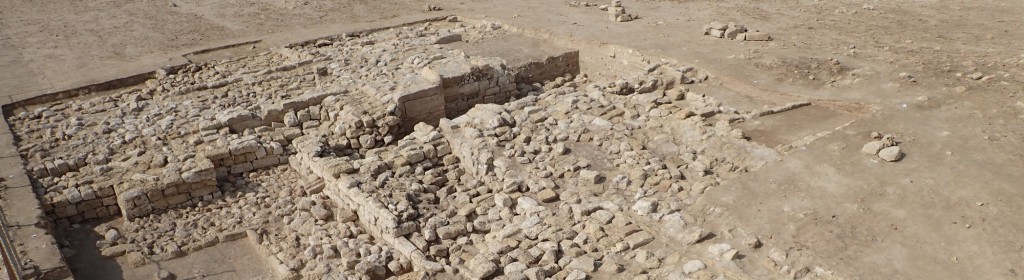
Éveha International’s collaboration focused on the excavation of the ancient city’s southeast gate. Identified through aerial photography and partially cleared in 2016 (Sector 2), this gate is integrated into a defensive system featuring an impressive bastion projecting outward by approximately 15 meters. Surface stripping of the gate and its defensive works continued in 2017, revealing the remains of their final architectural phase. This phase is characterized by the addition of two external thickenings, bringing the total width of the rampart—and its bastion—to over 10 meters: it is the most imposing fortification known in Eastern Arabia to date. Four test pits opened along the axis of the gate have documented at least four major architectural phases.