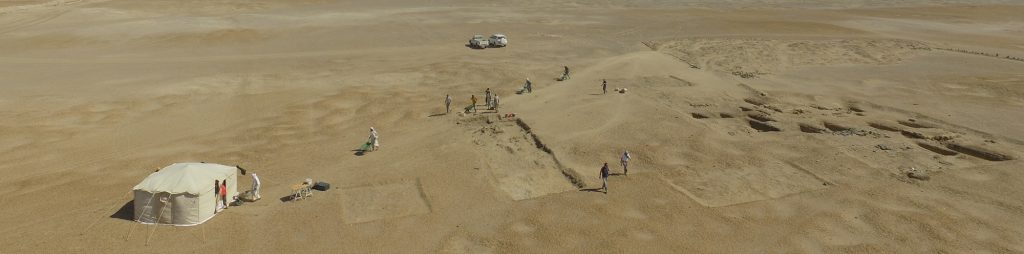
The island of Saï preserves innumerable archaeological vestiges testifying to human occupations from the Palaeolithic to the modern period. Since the 1950s, teams of French archaeologists have contributed to their study. Under the direction of Vincent Francigny (CNRS, UMR 8167 Orient & Méditerranée) since 2015, the current mission focuses mainly on the Pharaonic period fortified city and several Meroitic necropolises.
Direction
Vincent Francigny (CNRS,
UMR 8167 Orient & Méditerranée)
How Eveha International Participates
Archaeological field and lab research
Localisation
Soudan
Location and Historical Summary
Sai Island rises from the Nile in northern Sudan, approximately 200 kilometers from the modern border with Egypt—a border that has remained largely unchanged for five millennia. Due to this strategic location, the island has played a vital role in Nubian history. It spans 10 kilometers from north to south and 4 kilometers from west to east, hosting a vast array of archaeological remains.
The earliest traces of human presence date back 300,000 years, with several Paleolithic occupation levels identified. The Mesolithic and Neolithic periods are represented by various settlement sites.
The Kerma civilization (2500–1500 BC) is distinguished by an immense tumulus necropolis containing thousands of burials, stretching from east to west in the southern part of the island. Some of the tumuli marking these graves measure up to 40 meters in diameter, indicating the presence of a significant local elite.
The island became an Egyptian colony at the beginning of the New Kingdom (c. 1500 BC). A fortified town, including a temple dedicated to the god Amun, was constructed. Egyptian administrative officials were buried on the island in collective vaulted tombs. These structures were often reused during the Napatan period (early 8th to the first half of the 3rd century BC), a period also documented by a cemetery located southwest of the town.
Five necropolises from the Meroitic era (mid-3rd century BC – mid-3rd century AD) have been identified. Scattered blocks also attest to the existence of a temple erected in the 1st century during the reign of King Natakamani and Queen (Candace) Amanitore, though its exact location has yet to be determined.
The subsequent “Post-Meroitic” period has also yielded burials. Sai Island became a bishopric in the mid-6th century, and the ruins of a church and annexed buildings are still visible today. Following the Christian period, the Ottomans settled on the island in the 16th century, establishing a garrison whose fortifications were built upon the remains of the Pharaonic town.
Research History and Objectives
A French archaeological mission has been active on the island since 1954. It was first led by Jean Vercoutter, who later became the first Director of Sudan’s Antiquities Service. Over several campaigns, he carried out extensive excavation work on the Pharaonic town located on the eastern coast of the island. Since then, several French missions, sometimes involving international collaborations, have conducted research programs covering various historical periods.
The current mission, led since 2015 by Vincent Francigny, focuses its fieldwork on the excavation of the Pharaonic and medieval town, as well as two Meroitic elite necropolises, while studying and synthesizing data from previous decades.
Alongside the archaeological excavations, an on-site museum is currently under construction. It will allow local residents and visitors to discover the history of Sai through the ages. A major site protection program has also been established to preserve Sai’s invaluable heritage.
Partners
Orient & Méditerranée (CNRS UMR 8167) https://www.orient-mediterranee.com/
Section Française de la Direction des Antiquités du Soudan http://sfdas.com/
National Corporation for Antiquities and Museums
Ministère de l’Europe et des Affaires Étrangères
Faculté de médecine de Marseille – Unité d’anthropologie (CNRS UMR 7268 ADES)
University of Central Florida – Department of Anthropology https://sciences.ucf.edu/anthropology/